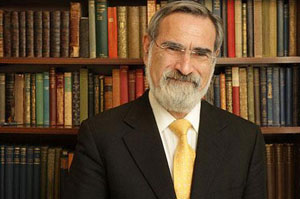
In the Hebrew Bible/Old Testament, the proof-text that God wants humankind to rise above our inbuilt tendency to religious hatred is found in the book of the prophet Isaiah:
‘And they shall beat their swords into ploughshares and their spears into pruning hooks. Nation shall not lift up sword against nation, neither shall they learn war any more’ (Isaiah 2:4).
But how do we get there?After all, that same Hebrew Bible has plenty of stories about war and bloodshed, seemingly in God's name:
There are many examples in the Hebrew Bible. There is the war of revenge against the Midianites. There is the war mandated against the seven nations in the land of Canaan. There is the book of Joshua with its wars of conquest, and the bloody revenge against the Amalekites in the book of Samuel.
Rabbi Sacks shows that the Jewish sages, beginning long centuries ago, have considered at great length the Bible's attitudes about war. Despite all the biblical wars that were fought "in God's name,"
By the eighth century BCE the prophets of Israel had become the first people in history to envisage a world at peace.
We get to peace in the name of God, says Sacks, through careful consideration of the entire context and the through-story of the Bible, not by just picking out an apt verse or gripping story here or there. This is what religious tradition is all about. Each of the three versions of Abrahamic monotheism — Judaism, Christianity, and Islam — has a long tradition of biblical interpretation and re-interpretation. We need to steep ourselves in such tradition.
* * * * *
When I was entering adulthood in the late 1960s, the Vietnam War was raging. I, like many others of my age group, was antiwar. A high-minded devotion to peace was everywhere on college campuses. We had our posters:

Our peace symbols:

Our peace signs:

It was all very high-minded. But it was not deeply rooted in religious tradition. The peace movement as a whole was pretty much religion-free. We baby boomers were questioning our religions and leaving them in droves.
True, there were branches of the peace movement emanating from various religions. I myself was particularly aware of Catholic protest against the war, as I was attending Georgetown University at the time. But most of the people making the V-sign for peace were not notably religious.
So the 1960s peace movement was like a helium-filled balloon floating in the stratosphere, with no string attaching it to the ground. It was ungrounded in any particular religious tradition. And as soon as the war was over, the balloon popped. Whatever peace movement we have today is highly fragmented and marginal.
Rabbi Sacks wants us to reconsider our Abrahamic, monotheistic religious traditions as ways of grounding our desire for peace.