 The book Not in God's Name: Confronting Religious Violence, by Rabbi Jonathan Sacks, tells us why it's a travesty of Abrahamic religion — Judaism, Christianity, and Islam — to wreak violence and perpetrate death on members of other faith communities. Especially, on sibling faiths.
For each Abrahamic religion, the sibling faiths are ... the other two. During the course of history, each one has killed members of the other two "in God's name." Today, Muslim jihadists are killing and brutalizing hundreds of thousands in the name of Allah.
They are taking the lives of Christians and Jews, not to mention secular atheists and just ordinary people in the West. They are also killing one another in untold thousands, simply because different Muslims come from different traditions. There are Sunnis and Shi'ites, as the West has learned. There are also numerous other sects underneath the Islamic umbrella.
Why all the killing?
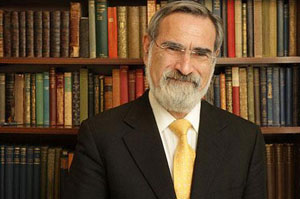 |
| Rabbi Jonathan Sacks |
In the biblical book of Genesis, the stories of Isaac and Ishmael, of Jacob and Esau, and of Joseph and his many brothers are all stories in which one particular sibling appears, at first reading, to obtain God's favor to the exclusion of the others.
Sacks takes apart each of these stories and shows how the first reading is not necessarily the right reading. Yes, the seemingly favored son is given, in each case, a covenantal responsibility that pertains to the establishment and development of monotheism in a polytheistic world. But God never withdraws his love from the other sons. Never.
The inescapable conclusion is that there are no people on earth that God does not love. Sibling rivalry is no excuse for murder.
* * * * *
The jihad being carried out today by radical Muslim warriors is a huge mistake for another reason, writes Sacks. It's ultimately about power, not religion.
Jews in what today is the state of Israel — called, by Christians, the Holy Land — rebelled against Roman rule in 66-73 CE, in the First Jewish-Roman War. They lost, and Jerusalem fell. "What makes the fall of Jerusalem relevant to the politics of the twenty-first century," Sacks writes ...
... is that it saw the first appearance in history of religiously motivated terror. The failed rebellion, together with its disastrous sequel, the Bar Kochba rebellion (132-5 CE), left Jewish life in ruins. The Temple was destroyed. Jerusalem was levelled to the ground and rebuilt as a Roman polis, Aelia Capitolina. The Jewish population began to drift elsewhere, to Babylon, Egypt and the Mediterranean basin. Thus began an exile that was to last almost two thousand years.
It was, in its way, though, the beginning of the marvelous modern-day Jewish mindset, inasmuch as:
Out of darkness, though, sometimes comes light. What Jews discovered when they had lost almost everything else was that religion can survive without power. Instead of the Temple they had the synagogue. Instead of sacrifices they had prayer and charity. Repentance, the direct turning of the heart to God, took the place of the high priest’s service on the Day of Atonement. In place of the nation state, they had communities scattered across the world yet united by a covenantal bond of mutual responsibility.
"Religion can survive without power": that's the key phrase for all of us, not just Jews. Not only that: "Religion and power," Sacks writes, "are two different things altogether."
* * * * *
 |
| Martin Luther |
... set in motion far-reaching changes in the political map of Europe, challenging the authority and power of Rome. For more than a century, Europe became a battleground, an epidemic of wars brought to an end only by the Treaty of Westphalia in 1648.
Europe would then see the rise of secular science and a "new mode of philosophy [in a] mutual "quest for basic principles that did not rest on dogmatic religious foundations." Suddenly, religion was losing its disctatorial grip over people's lives.
But all was not lost. Religion and power became disentangled in the West, that was true ... and it was a good thing. Sacks says:
More gradually, but also more extensively, Western Christianity had to learn what Jews had been forced to discover in antiquity: how to survive without power.
So, perhaps Muslims are today in the process of learning this basic truth which Sacks brings out so starkly: "Monotheism allied to power fails."

No comments:
Post a Comment